Smart - IT right in the middle, instead of just DIGITAL
or: The dream of a business app store comes true! en
Steffen Schaar, Member of the Managing Board ot The Quality Group GmbH
Published in: DiALOG - DAS MAGAZIN FÜR ENTERPRISE INFORMATION MANAGEMENT | March 2017
Agile and digital working will challenge us even more than previously thought, regardless of whether we are ‘digital immigrants’ or ‘digital natives’. Being ‘digital’ is IN, and being part of it is everything, because we all have smartphones! Printing, faxing, scanning, filing, talking and meeting are a thing of the past. Today, we are mobile, digital, virtual and we are on the go in chat rooms, ready for social media around the clock. Everyone? More than 50% understand digitalisation to mean sending emails. ‘Digital transformation’ – what is that, do I want it? Yes, very much so, but what can I expect? Fears and expectations therefore come free of charge on top.
My head is full, time is short and tasks are growing daily. How can I keep up without being left behind, without standing out in the digitalisation frenzy of agile changes, new demands and the call for ‘artificial intelligence’? The ‘natives’ call it cool, part of IoT or Web 3.0, others swear by M2M and Industry 4.0. Soon there will be World 5.0 – ‘Are you serious?’ you ask yourself.
Führung wird immer wichtiger
Zweifellos, die meisten Unternehmen werden sich in den kommenden Jahren stark verändern. Neben ihren Strukturen und den Arbeitsbeziehungen in ihnen werden sich oft auch ihre Geschäftsmodelle wandeln. Doch eines wird sich nicht verändern: der Mensch Mitarbeiter. Er wird sich weiterhin Halt und Orientierung wünschen – gerade wenn im Unternehmen selbst und in dessen Umfeld scheinbar alles im Fluss ist.
Doch wer soll ihm dieses Gefühl vermitteln, wenn im Unternehmen sozusagen alles permanent auf dem Prüfstand steht? Letztlich können dies nur die Führungskräfte sein. Deshalb ist die These nicht gewagt: Führung wird künftig in den Unternehmen immer wichtiger werden – gerade weil es im Unternehmenskontext sonst nichts mehr gibt, worauf man als Mitarbeiter bauen und vertrauen kann.
Führung muss sich ändern
Soweit, so beruhigend. Das bedeutet jedoch keineswegs, dass sich Führung nicht verändert. Im Gegenteil! Die Art zu führen, muss sich im digitalen Zeitalter radikal wandeln. Denn folgende Entwicklungslinien sind in den Unternehmen unverkennbar.
- Die für den Unternehmenserfolg relevanten Leistungen werden zunehmend von bereichs- und oft sogar unternehmensübergreifenden Teams erbracht.
- Die für die Kunden erbrachten Lösungen setzen immer mehr Spezialwissen voraus, das die Führungskräfte oft selbst nicht haben.
- Die von den Unternehmen erarbeiteten Strategien, Planungen usw. haben eine immer kürzere Gültigkeitsdauer. Und:
- Die Führungskräfte und ihre Bereiche stehen immer häufiger vor Herausforderungen, für die sie noch keine Lösung haben.
Wie ist in einem solchen Umfeld erfolgreiche Führung möglich – wenn die Führungskräfte einen immer geringeren (disziplinarischen) Zugriff auf ihre Mitarbeiter haben und – salopp formuliert – auch nicht schlauer als diese sind?
Führungskräfte müssen „Marken“ werden
Nach dem klassischen Befehl- und Gehorsam-Prinzip ist dies nicht möglich; ebenso wenig dadurch, dass die Führungskräfte versuchen, sich als Alles-besser-Wisser zu profilieren. Der einzig mögliche Lösungsweg ist: Die Führungskräfte müssen sich zu echten Leadern entwickeln, also Persönlichkeitsmarken, denen die Mitarbeiter vertrauen.
Eine Marke kennzeichnen zwei Faktoren. Erstens: Sie ist aufgrund ihres Auftritts beziehungsweise Erscheinungsbilds wiedererkennbar. Und zweitens: Sie gibt den Kunden ein klares Leistungsversprechen – so wie dies zum Beispiel die Unternehmen Audi und BMW mit ihren Slogans „Vorsprung durch Technik“ beziehungsweise „Freude am Fahren“ tun.
Erkennbar für gewisse Werte stehen
Ähnlich verhält es sich mit Fühungskräften, die eine „Persönlichkeitsmarke“ sind. Auch sie stehen für ihr Umfeld erkennbar für konkrete Werte und Überzeugungen, die sich in ihrem Verhalten zeigen. Also lautet eine Anforderung an Führungskräfte, die eine Persönlichkeitsmarke werden möchten: Sie müssen sich ihrer Werte und Überzeugungen sowie Stärken bewusst werden – also darüber, was sie als Person einzigartig und unverwechselbar macht. Dazu zählt auch das Kennen der eigenen Schwächen. Denn erst aus dem Bewusstsein unserer Stärken und Schwächen erwächst das erforderliche Selbstverständnis für unsere mögliche Wirkung. Und dieses hilft uns wiederum, nicht nur an „Schönwetter-Tagen“, sondern auch, wenn es (im Unternehmen oder Markt) „stürmt und schneit“ eine souveräne Haltung einzunehmen und zu zeigen. Und dies ist wiederum ein Signal für unsere Umwelt: Dieser Marke beziehungsweise Person kannst du vertrauen.
Sich präsentieren und vermarkten
„Werden Sie als Führungskraft eine Marke und präsentieren und vermarkten Sie sich entsprechend“ – diese Aufforderung stößt bei vielen Führungskräften auf Vorbehalte. Denn mit dem Begriff „Vermarktung“ assoziieren sie Attribute wie „schrill“ und „laut“. Doch nur wenige Marken sind so schrill und laut wie Afri Cola. Weit mehr setzen auf ein unaufgeregtes Under-Statement.
Ähnlich verhält es bei der Selbst- Vermarktung von Führungskräften. Auch hier geht es nicht darum, stets am lautesten zu schreien, sondern immer wieder nach außen zu zeigen und zu artikulieren,
- wofür man steht und
- was einem als Person wichtig ist.
Denn so entstehen Glaubwürdigkeit und somit Vertrauen. Und diese Faktoren werden für den Führungserfolg in der von Veränderung geprägten VUCA-Welt immer wichtiger.
As a medium-sized consulting and software company with employees from ‘Generation What’ (Europe's largest youth study in 2016 refers to 18-34 year olds as such) and many experienced
experts from the pre-internet generation, we see ourselves as having a special responsibility. For decades, we have designed our product and service portfolio to provide solution-oriented support for efficient administrative processes in organisations. Open and trusting communication with our partners and users has always been one of our guiding principles. We believe that this is the only way we can not only drive the trends and innovations of the time technologically (that's what we're IT for), but above all support the agility of organisational changes and tasks with IT solutions in a meaningful and efficient way.
Years ago, people said, ‘The interface must be easy to use.’ Today, we are redefining our standards for ‘smart’ working, not tomorrow, but today.
Examples of rapid, technology-driven changes in work and organisation include BYOD (bring your own device) in IT and P2P (purchase to pay) in purchasing. Recently, corporate lawyers and compliance officers have been describing their challenges in terms of “legal tech” (legal and technology). They all have one thing in common: they are about simplifying daily tasks, ensuring compliant processes and transparent documentation with the “pencil of the 21st century” – IT. But what does that mean, and what does it look like? Do I have to adapt, relearn, change? Isn't “smart” just simple? No!
Digital working is changing our processes and our attitudes, and in the coming years it will require one thing above all else: building trust in the virtual world. Our work tools will also continue to change. Screens, information dashboards and tableaux are getting bigger and bigger, data volumes are growing exponentially, and our decisions are also expected to be agile, online and mobile. ‘Good heavens,’ one might say, ‘we just want to understand, participate, think, act, benefit, be modern and... above all, be successful.’
‘Simple’ was yesterday – ‘complex’ is today – ‘live & smart’ is tomorrow
about every second of waiting time when loading information on the screen. When the Wi-Fi is down and the app is no longer usable, we go crazy. And why isn't the button there, but there?
We take it for granted that data protection and authorisation for accessing data are guaranteed, that data networks function permanently and ubiquitously
– in short: ‘IT must always work’. These demands alone prevent us from seeing the truth: IT does not take away our culture of action or our culture of communication; we just have to deal with it differently. On the contrary, expectations are potentially increasing: ‘Faster, faster, it has to work!’ But what will the post office of tomorrow actually look like?
More and more people are dealing with digital information in business, and more and more are discovering opportunities instead of just seeing risks. They are thinking about the potential of information exchange instead of just completing their daily tasks with tunnel vision. This calls for providing the trendsetters among us with smart, easy-to-design platforms and solutions for transparent, cross-departmental documentation of information.
We need a reliably documented and shared between employees. Respectful interaction is a given, of course. And I am already curious to see how I can adapt my ‘desk’ as an individually configurable platform (software) option so that I can work in the way that suits me best. In other words, handling information securely in line with my tasks and area of responsibility, finding it and, if possible, sharing it within the team. The focus here is on creating trust in the digital world through transparency and commitment, as well as integrating and modelling human, intuitive behaviour into digital processes.
Introducing company-wide information and knowledge management in (semi-)automated organisational processes in a way that is bindingly measurable, audit-proof and compliant is actually common sense. However, we know from past experience that a good continuous improvement process (CIP) can only be implemented by a motivated workforce. Not ‘big data’ and ‘small details’.
derive organisational, action and change management from them. As a team, quickly, transparently, bindingly, measurably!
That's why it's ‘smart’ to perform our tasks in future from the workplace, from home or on the move (mobile) by
- Interactive & networked login screens (eUserGuide, TicketSystem, social platform, SupplierChatroom, InformationDesk, portal links, etc.)
- Role-based and subject-specific, individually designed work desks with functional standard apps
- Intelligent, stored and reusable processes to simplify daily routines
- Intuitive & context-related information display and processing in just a few steps
- (Smart)EasySearch & fuzzy logic (accuracy at full text level)
- Direct share mechanisms (work desk, reports, etc.) for solving team-oriented and distributed tasks securely, easily and efficiently.
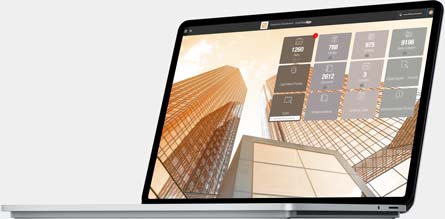
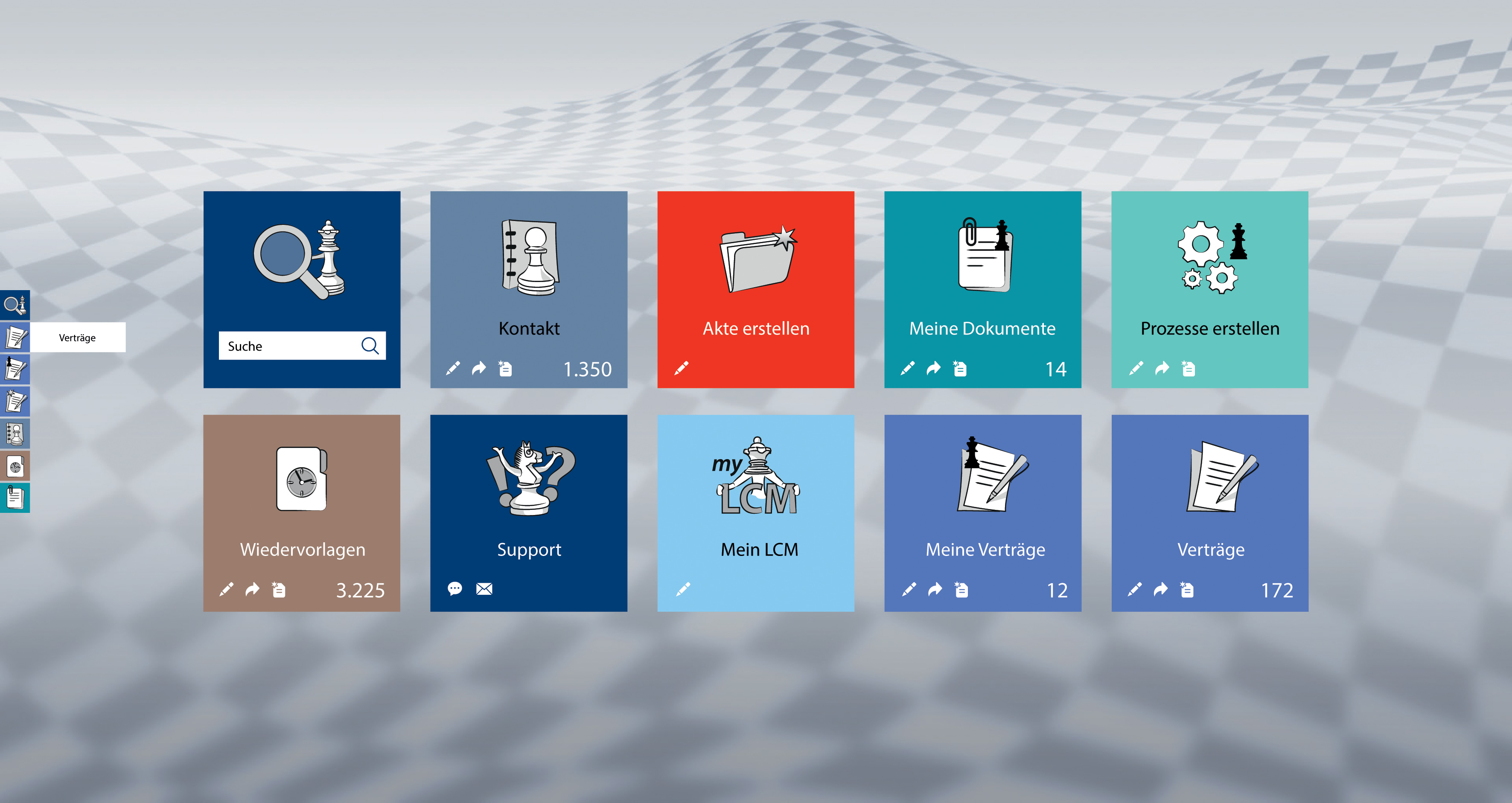
The new IT buzzword is businessApp platform. A platform contains role-based, configurable desktops, known as business apps (see Fig. 1), where users can work efficiently and as easily as possible within their area of responsibility. The administrator/user can define or develop the smart app modules themselves. They do not need to know any programming languages to do this, but can define the business app using a 3-step smart model in a purely visual configuration. The 3-step smart model consists of
- Selecting a module from the platform or defining an organisational process
- Configure module parameters or draw/visualise the process flow using a digital tool (BPMN2.0 notation)
- Connect the ‘app tile’ in the business platform to the module or organisational process.
This means that user-defined, cross-departmental organisation and its processes become everyday practice thanks to an information hub (platform). Whether applications (apps) for the legal tech or smart contract approach, M2M, compliance excellence or supplier management, IT has laid the foundations with the businessApp platform.
Now everyone is called upon to not only experience the digital transformation from the ‘Office 5.0’ vision – or paperless organisation – but also to help shape it.
TQG businessApp cloud platform
As a leading German standardised solution, the TQG businessApp cloud platform supports audit-proof and structured information and knowledge management in organisations for any objects in their life cycle, such as contracts, files, processes, cases, applications or notifications.
Special features of the configurable platform include the structuring, bundling and linking of data and responsibility for information for a specific purpose, as well as supporting employee interaction by embedding information in the context of action through freely definable business processes.