
Change begins in the mind
Digital Transformation: People, Motivation, Methodology
Published in: DiALOG - DAS MAGAZIN FÜR ENTERPRISE INFORMATION MANAGEMENT | MÄRZ 2017
"We are becoming increasingly aware that the most important questions are not technical, but human ones," wrote the legendary management pioneer Peter Drucker back in 1967. Today, as we experience digital transformation firsthand, this reminder raises a number of questions that companies need to address when considering their digital transformation journey. We discussed these issues with Steffen Schaar, member of the executive management team at The Quality Group. The company has established a strong reputation particularly through the combination of process-oriented consulting and technical solution expertise.
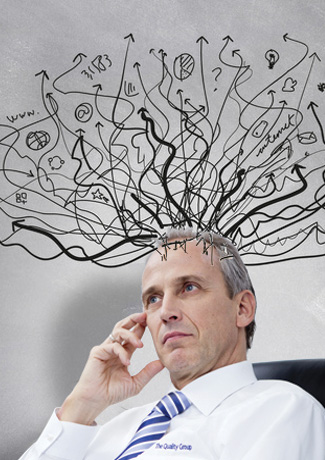
Editorial team: Mr. Schaar, the term “Digital Transformation” seems to herald a new era in business and society. It immediately brings technologies to mind, and the IT industry also sees significant market potential in this development. But are technologies not merely the tip of the iceberg?
Schaar: Change comes from people. People must shape the business processes; these processes must not simply be imposed on them. A great deal of money is continuously invested in IT projects, but many projects fail or at least deviate significantly from the originally planned budget. Why is that? Because the focus is primarily placed on technologies rather than on the organizational processes that are meant to be supported by those technologies.
Führung wird immer wichtiger
Zweifellos, die meisten Unternehmen werden sich in den kommenden Jahren stark verändern. Neben ihren Strukturen und den Arbeitsbeziehungen in ihnen werden sich oft auch ihre Geschäftsmodelle wandeln. Doch eines wird sich nicht verändern: der Mensch Mitarbeiter. Er wird sich weiterhin Halt und Orientierung wünschen – gerade wenn im Unternehmen selbst und in dessen Umfeld scheinbar alles im Fluss ist.
Doch wer soll ihm dieses Gefühl vermitteln, wenn im Unternehmen sozusagen alles permanent auf dem Prüfstand steht? Letztlich können dies nur die Führungskräfte sein. Deshalb ist die These nicht gewagt: Führung wird künftig in den Unternehmen immer wichtiger werden – gerade weil es im Unternehmenskontext sonst nichts mehr gibt, worauf man als Mitarbeiter bauen und vertrauen kann.
Führung muss sich ändern
Soweit, so beruhigend. Das bedeutet jedoch keineswegs, dass sich Führung nicht verändert. Im Gegenteil! Die Art zu führen, muss sich im digitalen Zeitalter radikal wandeln. Denn folgende Entwicklungslinien sind in den Unternehmen unverkennbar.
- Die für den Unternehmenserfolg relevanten Leistungen werden zunehmend von bereichs- und oft sogar unternehmensübergreifenden Teams erbracht.
- Die für die Kunden erbrachten Lösungen setzen immer mehr Spezialwissen voraus, das die Führungskräfte oft selbst nicht haben.
- Die von den Unternehmen erarbeiteten Strategien, Planungen usw. haben eine immer kürzere Gültigkeitsdauer. Und:
- Die Führungskräfte und ihre Bereiche stehen immer häufiger vor Herausforderungen, für die sie noch keine Lösung haben.
Wie ist in einem solchen Umfeld erfolgreiche Führung möglich – wenn die Führungskräfte einen immer geringeren (disziplinarischen) Zugriff auf ihre Mitarbeiter haben und – salopp formuliert – auch nicht schlauer als diese sind?
Führungskräfte müssen „Marken“ werden
Nach dem klassischen Befehl- und Gehorsam-Prinzip ist dies nicht möglich; ebenso wenig dadurch, dass die Führungskräfte versuchen, sich als Alles-besser-Wisser zu profilieren. Der einzig mögliche Lösungsweg ist: Die Führungskräfte müssen sich zu echten Leadern entwickeln, also Persönlichkeitsmarken, denen die Mitarbeiter vertrauen.
Eine Marke kennzeichnen zwei Faktoren. Erstens: Sie ist aufgrund ihres Auftritts beziehungsweise Erscheinungsbilds wiedererkennbar. Und zweitens: Sie gibt den Kunden ein klares Leistungsversprechen – so wie dies zum Beispiel die Unternehmen Audi und BMW mit ihren Slogans „Vorsprung durch Technik“ beziehungsweise „Freude am Fahren“ tun.
Erkennbar für gewisse Werte stehen
Ähnlich verhält es sich mit Fühungskräften, die eine „Persönlichkeitsmarke“ sind. Auch sie stehen für ihr Umfeld erkennbar für konkrete Werte und Überzeugungen, die sich in ihrem Verhalten zeigen. Also lautet eine Anforderung an Führungskräfte, die eine Persönlichkeitsmarke werden möchten: Sie müssen sich ihrer Werte und Überzeugungen sowie Stärken bewusst werden – also darüber, was sie als Person einzigartig und unverwechselbar macht. Dazu zählt auch das Kennen der eigenen Schwächen. Denn erst aus dem Bewusstsein unserer Stärken und Schwächen erwächst das erforderliche Selbstverständnis für unsere mögliche Wirkung. Und dieses hilft uns wiederum, nicht nur an „Schönwetter-Tagen“, sondern auch, wenn es (im Unternehmen oder Markt) „stürmt und schneit“ eine souveräne Haltung einzunehmen und zu zeigen. Und dies ist wiederum ein Signal für unsere Umwelt: Dieser Marke beziehungsweise Person kannst du vertrauen.
Sich präsentieren und vermarkten
„Werden Sie als Führungskraft eine Marke und präsentieren und vermarkten Sie sich entsprechend“ – diese Aufforderung stößt bei vielen Führungskräften auf Vorbehalte. Denn mit dem Begriff „Vermarktung“ assoziieren sie Attribute wie „schrill“ und „laut“. Doch nur wenige Marken sind so schrill und laut wie Afri Cola. Weit mehr setzen auf ein unaufgeregtes Under-Statement.
Ähnlich verhält es bei der Selbst- Vermarktung von Führungskräften. Auch hier geht es nicht darum, stets am lautesten zu schreien, sondern immer wieder nach außen zu zeigen und zu artikulieren,
- wofür man steht und
- was einem als Person wichtig ist.
Denn so entstehen Glaubwürdigkeit und somit Vertrauen. Und diese Faktoren werden für den Führungserfolg in der von Veränderung geprägten VUCA-Welt immer wichtiger.
The processes, however, are a matter of people—particularly the people and employees in the business departments who define the underlying workflows. Despite all digitalization efforts, the entire corporate organization and the employees directly involved in these processes must be taken along on the digital journey.
Editorial team: People are often attached to familiar workflows and processes. They are reluctant to replace them with new ones, aren't they?
Schaar: I would have to disagree with you. People are much more interested in making processes more efficient when they see a purpose behind them. They know that knowledge management, quality assurance and quality improvement, process transparency, and compliant conduct are among the most important competitive factors. Processes must be designed accordingly.
Editorial team: We are currently experiencing that many of these factors are not taken seriously by everyone in business—as the example of VW demonstrates.
Schaar: The example you mentioned shows that structured information management, particularly through cross-departmental processes, can create a high degree of transparency and thus enable such far-reaching strategic failures to be identified and avoided at an early stage. A well-designed process organization helps evaluate and analyze risks that may arise from strategic initiatives. As in the example you mentioned, the saying “Good is the enemy of excellent” takes on a tragic meaning, because “good” belonged to yesterday. In times of agility and digital transformation, a culture of continuous renewal and control must be embedded in people’s minds more than ever before.
Editorial team: Let us return to the drivers accelerating digital transformation: mobile systems, especially smartphones, connectivity and the associated growth in data volumes (Big Data), as well as the cloud. How must companies prepare for these developments?
Schaar: With digitalization, we are experiencing a new era in dealing with information—both from the perspective of consumers and from the perspective of providers of products and services. For companies, this means integrating knowledge and processes instead of thinking in terms of departments, creating transparency instead of merely collecting and accumulating data, and adopting a business process mindset instead of an IT mindset.
Editorial team: What exactly do you mean by business process thinking versus IT thinking?
Schaar: Too often in recent years, IT has been allowed to decide what potential the business departments could achieve through technology. Today, we are increasingly seeing business departments themselves describe their organizational potential based on the continuous improvement process (CIP/KVP) and then actively maintain and develop it. After all, it is often only the experience of a problem that creates the motivation for improvement. This has not changed even after more than ten years of Business Process Management (BPM).
"For digitalization, we need IT, but it is not the goal—it is the tool."
Editorial team: Does this mean that Business Process Management as we know it today needs to be reconsidered? Do we need more adaptive process management, shaped primarily by the business departments?
Schaar: Process design undoubtedly belongs in the business departments. This applies especially to clearly business-specific processes. IT must become a service provider for the business departments. This requires understandable communication between the two areas of the company. However, the real challenge lies in creating greater flexibility within organizational structures. Areas of responsibility may need to become more interconnected, and greater agility is required within business departments as well as between interdependent departments and business units. Knowledge management must be designed across the entire organization and, where appropriate, supported by technology.
Editorial team: Your company, The Quality Group, is among the pioneers that have moved away from the term ECM, Enterprise Content Management—commonly understood as document management—and instead adopted EIM, Enterprise Information Management. Why?
Schaar: EIM no longer describes IT solutions or technologies themselves, but rather the value created through IT solutions. Over the past few years, we have therefore further refined and developed our definition of EIM. We currently describe the benefits of EIM through an approach focused on increasing transparency of processes and contracts, accelerating standards across the organization, minimizing risks, and ensuring compliance. The right information, at the right time, in the right place—information processes that are shaped by all employees.
It begins with conscious, sustainably designed communication and aims to establish structured, cross-departmental information processes. For this purpose, we provide strategic consulting services and solutions for the sustainable management of information—solutions that are structured and measurable. Unfortunately, measurability has traditionally been unfamiliar territory in administrative areas. With EIM, approaches are established and implemented that use KPIs (Key Performance Indicators) to provide a tangible, practical improvement approach for structuring and controlling information.
This is why our consulting methodology is called OPH – Organizational and Process Handbook—and why one of our solution approaches is an electronic product suite called LCM – Life Cycle Management for Enterprise Information Management.
"For us, EIM is a methodology that addresses virtues, values, standards, and quality awareness."
Editorial team: So, do you consider ECM to be an approach that is no longer up to date?
Schaar: The question is not whether ECM is right or wrong. More than a decade ago, ECM provided a structured description of how content could be managed. Today, priorities have shifted toward structuring information from an enterprise-wide perspective and toward quality-conscious management. The technical approaches of ECM will continue to accompany us as a foundation. They provide the basis for continuing to integrate digital applications—whether content management, collaboration, or many other ECM functions—into EIM.
However, for us, EIM is a methodology that addresses virtues, values, standards, and quality awareness. For digitalization, we need IT, but it is not the goal—it is the tool. And for digital transformation, we need employees and a corporate culture that actively shapes the digital organizational structure.
Editorial team: Your company, together with VOI, established an award called the DiALOG Award, which is being announced for the fourth time this year. Why do you call the award the DiALOG Award rather than the EIM Award?
Schaar: For the sake of completeness, I would like to add the subtitle: “Excellence with EIM.” The name “DiALOG” reflects our guiding principle and the current requirements, particularly with regard to digital transformation in business and companies. It stands for dialogue with our customers as a strategic concept; it stands for dialogue within our consulting strategy; and it also represents dialogue between departments within companies and the people involved.
We want to support this dialogue through our EIM methodology. Ultimately, dialogue also represents communication between corporate customers and their providers. Because the customer as a person and employee is becoming an even more important link in the value chain of companies as digitalization continues to advance.
This is what motivates the award, and the addition of “Excellence” establishes special standards for continuous, sustainable, and innovative action.
Editorial team: Thank you for the interview, Mr. Schaar.